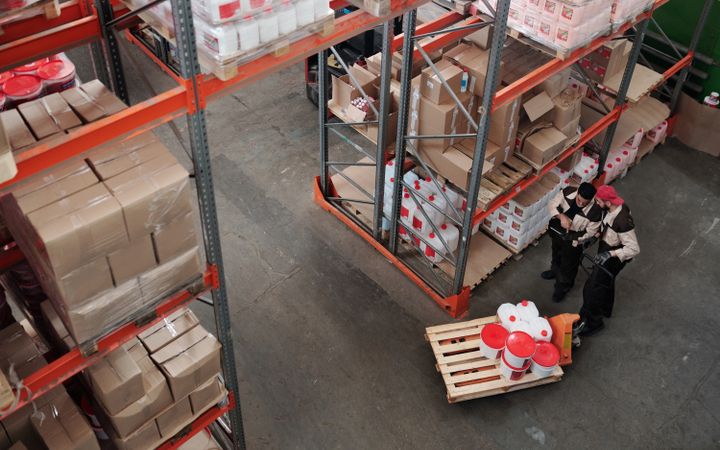
Shortening the picking route
Pickers spend much of the day walking; a shorter route is the cheapest speed-up.
A picker spends most of the day on their feet, and the walking itself adds no value for the customer. That is exactly why shortening the route is the cheapest speed-up: you do not have to buy new racking, equipment or software; in many cases it is enough to rethink where goods are placed and how picking is ordered. Here is how to do it.
Measure first: how far do you walk
Before reducing anything, know where you stand. The simplest method is to put a phone with a step counter in a picker's pocket and read the result at the end of the shift. If it shows 12,000 steps, that is roughly 8 to 9 kilometres. The second method is to watch a picker for an hour and record with a stopwatch how much time went on walking and how much on taking items and handling the sheet.
Draw a simple plan of the warehouse: aisles, their length, receiving and dispatch points. Then the main metric appears: how many metres of walking there are per picked line on average. Everything you do to shorten the route aims to reduce this number. For example, if 480 lines are picked in a shift over 9 kilometres, the average is 19 metres per line.
Route order
The step that gives the fastest result is sorting the pick list by item location. When the system or Excel orders the list by location code, the picker does not dart around the warehouse but goes through aisle after aisle. If the system does not do this, sorting by location code in Excel takes a minute. If the list follows the order in which items were ordered, a person may return to the same aisle three times.
The second step is an S-shaped route: walk an aisle from start to end, then move to the next, and so on. For example, an aisle is 40 metres long and ten aisles are needed. Entering each one and coming back means 800 metres of walking. Going through in one direction in an S shape gives about 400 metres. If an aisle has only one item, going back is better, so choose the rule according to the aisle's load. In narrow aisles, one-way movement prevents congestion.
Changing the layout
Sometimes the only way to shorten the route is to move the goods. Put the fastest sellers close to the exit and on the lower levels (this is covered in detail in the article on ABC analysis). Place items that often appear in orders together next to each other: for example, cable and sockets, paint and rollers. To find the pairs, it is enough to load the last three months of orders into Excel and count the items that appeared in the same order.
Another solution is to separate the picking location from the reserve location. The picker takes from a small nearby "front" spot, and a separate worker refills it from above or behind. Then the picker does not have to walk the whole length of the aisle.
Cart, codes and tidiness
If the cart has several bins, the worker can pick several orders in one trip. This is batch picking, and its advantages are described in a separate article. If a scanner shows the next location instead of a paper sheet, time is saved and errors decrease.
Codes should increase in the order of travel: aisle, rack, level, position, for example B-04-2-3. Put a large sign at the start of each aisle and a readable label on every rack. Aisles must not hold empty pallets, cardboard or returns: they lengthen the route and undermine safety.
Checking the result
After the changes, repeat the measurement: the same step counter, the same stopwatch, the same metric, that is, metres per line. Do not trust the result of a single shift; take the average of at least a week, because days differ in the mix of orders. If the step count falls from 12,000 to 9,000, a picker walks about two kilometres less a day, and that time goes back into picking. Discuss the new order with the pickers: they know better than you where it is cramped and awkward. Try a good suggestion and make it a rule.
Conclusion
Shortening the route takes three steps: measuring, sorting the pick order and bringing fast movers closer. During a warehouse audit, SkladKontrol observes pickers' routes and helps identify where excess walking occurs.