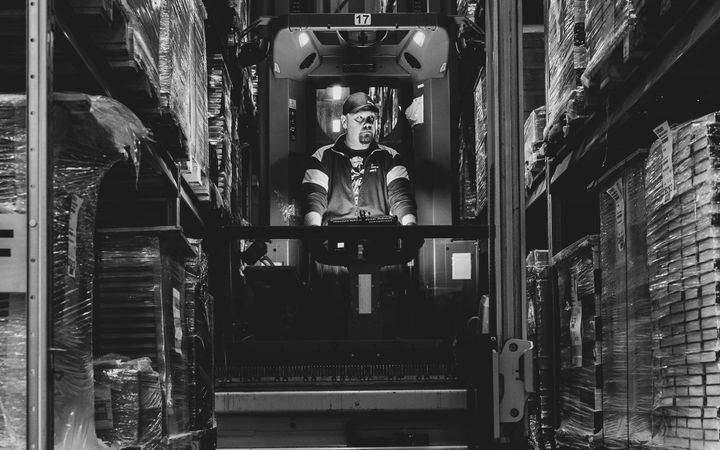
Regular maintenance of warehouse equipment
Forklifts, trolleys and scales that get scheduled checks break down less often and do not stop work.
Warehouse equipment usually breaks down at the worst possible moment: when a truck is waiting at the dock, on a seasonal peak day or at the end of a shift. At that point the phrase "there is no money for repairs" goes out of date, because a day of downtime costs more than the repair. To avoid letting equipment reach a sudden breakdown it needs inspection, and the inspection has to be orderly. Below is how to set it up.
What a day of downtime costs
Say a forklift moves 15 pallets an hour, which is 120 pallets in a shift. If it stands broken for two days, 240 pallets are delayed. Catching up takes 16 hours of driver time, possibly a hired truck and waiting time for vehicles. On top of that customer orders are late. Multiply these figures by your own hourly rates: the result will be much larger than the cost of routine checks.
An equipment register
First, know what you own. Create a passport for each machine; an Excel table is enough: name, asset number, serial number, purchase date, hours worked, dates of the last and next service, person responsible. Stick a plate with the asset number on every machine. Then the question "when was the oil changed on that forklift" is answered from the log, not from memory.
Three levels of inspection
One person cannot be loaded with everything, so split the inspection into three levels.
- Daily, the operator: the pre-shift check, cleaning the machine, reporting a fault immediately (we wrote about this for forklifts in a separate article).
- Weekly or monthly, the warehouse manager or a technician: fluid and oil levels, battery condition, tyres and wheels, chains and cables, connections, the scale returning to zero, cleaning scanners and printers.
- Planned servicing, a mechanic or the manufacturer's representative: by hours worked or by time. Take the interval from the manufacturer's manual and do not change it.
For each level draw up a one-page list: eight to ten items, each marked "good", "watch" or "faulty". A machine marked "faulty" is not used until the repair is finished. If it is not written down who carries out the inspection and who receives the result, the inspection ends up being nobody's job.
Planned servicing cannot be replaced with the principle of "we'll fix it when it breaks". An oil filter costs next to nothing, but a late change leads to an expensive repair of the engine or the hydraulics.
Scales, scanners and printers
These three devices look cheap, but when they do not work, the records are thrown off.
- Scales: check the zero reading and a load of known weight every day. A 1 percent error on 10 tonnes of flour gives a difference of 100 kilograms, which is either a loss or a surplus given to the customer. Confirm the cases and intervals in which official verification is required with the relevant service.
- Scanner and data terminal: battery capacity, the condition of the screen and the reading window, the charging station. If a battery dies in the middle of a shift the whole team stops, so one spare scanner should be on hand.
- Label printer: clean the print head from time to time with an alcohol wipe, and keep a stock of ribbon and labels. If the print is faint a barcode cannot be read and the employee switches to writing by hand.
Repairs, spare parts and the log
Keep fast-wearing parts in stock (wheels, filters, oil, fork fixings, the print head). Sign a contract with a mechanic and agree their arrival time. During repair take out the key, hang an "Under repair" tag on the machine, and let nobody work beneath raised forks.
Record every breakdown in the log: date, what broke, how long it stood idle, the cause, the cost of repair. After a year the log shows which machine breaks most often. A rough rule: if more than half of a machine's value has gone on repairs in a year, it is time to think about replacing it.
Conclusion
Equipment inspection turns an unplanned stoppage into planned work, and the register, three-level checks and breakdown log are there for that. Through its fixed-assets service, SkladKontrol puts warehouse equipment on a register and tags it with asset-number labels, which is the foundation of an equipment register.